Sunday, January 23, 2011

Book Thirteen - Brave New World


Apocalyptic fiction has got to be one of my favorite genres of literature. It allows for such creativity and the imagining of entirely different worlds, radically different societies, but is somehow much more powerful (for me, anyway) than simple scientific fiction. Apocalyptic fiction, after all, is not set on a distant alien planet, but on our own, in our own futures. And so, as much as we marvel and even mock the strangeness of these future societies, you can't help but ask yourself, "Could we ever get there?"

If I had to pick out the most likely apocalyptic landscape, I would turn to Oryx and Crake, by Maragret Atwood. The fact that it is not on THE LIST is a crime against literature; this book is brilliant, and I cannot stress reading it enough, especially if you work in any scientific field. If I had to hedge my bets, I'd say the world was going to end just in the way Atwood described. In the few years since she published it, we're already moving further into the crazy GMO, science, and virus obsessed 'utopia' she imagined. But I'm not here to talk about Oryx and Crake, I'm here to talk about Brave New World, which is another apocalyptic fiction that I could see coming true all too easily. While 1984 is terrifying and plausible, I cannot imagine our society transforming into a society like that unless a major global catastrophe happened which would circumvent our love of personal liberty and replace it with a desire for security. Brave New World is a much more plausible scenario- it seems only logical that a society of endless distraction and pleasure would be more stable than a society based on repression and secret killing. There are three pillars of the society in Brave New World that I think would ensure its longevity- soma, which eliminates not only bad feelings but also the capacity to treat them as something serious, conditioning, which the book proves to be an almost unshakable force, and the deportation of all who resist the first two measures to Islands, where they will be isolated and have their intellectual curiosities met, effectively neutralizing them as a threat to society. No random midnight killings, no bombings, no torture - this society of weird electric golf and pornography seems rather tame in comparison your normal post-apocalyptic wasteland. But you can see how this sort of thing can sneak up on you- and we can already see it somewhat in our society, with our excessive pursuit of leisure, material goods, and artificial happiness (i.e drugs, alcohol, American Idol). Slippery slope?

Anyway, I could talk about the brilliance of this book forever and ever, but I think the most mind-blowing scene is by far the conversation of between the Savage and Mustapha Mond. It's not dissimilar to the scene between Winston and O'Brien in 1984, the old tried and true "villain explains to his helpless victim the Great Evil Scheme," but this conversation is different. Mustpha Mond clearly treats the Savage as an equal, despite their vastly different situations, and overall it reads like a pleasant chat between two friends on the finer points of philosophy. But of course, it's not. It's nothing less than the fundamental argument between two vastly different ways of life: the sentimental past (argued by the Savage) and the rational future (argued by the Commander). And you're supposed to hate Mond, he's the Bad Guy, but you can't help but see that he's perfectly right, in everything he's saying. It's just such a brilliant exchange, I wish I could quote it all, but I particularly loved the bits about religion, so here...

'"Then you think there is no God?"
"No, I think there quite probably is one."
"Then why?..."
Mustapha Mond checkered him. "But he manifests himself in different ways to different men. In premodern times he manifested himself as the being that's described in those books. Now..."
"How does he manifest himself now?" asked the Savage.
"Well, he manifests himself as an absence. As if he wasn't there at all."'

Brilliant. So one last point; whenever I read these kind of books, you feel bad for the poor people in them, like Lenina, who are clearly off their rockers but can't do anything about it because of their conditioning and society and blah blah blah. But today I was reading about modern dictatorships for class and thinking about this book and realizing that we've probably been "conditioned" too, in different ways, so subtlety that we don't even realize it. I'm not saying we were all forced to listen to a thousand repetitions of "Buy McDonalds hamburgers," in our sleep, but in some ways the control modern society has over us probably makes us a lot more like Lenina than we think. Scary thought...

In summary: This book was published in 1932. Unless you are under the age of thirteen or illiterate, you have no excuse for not reading it yet. Get on it.

Friday, January 7, 2011

Book Twelve- Sputnik Sweetheart


So since it was my first week back to work, I decided to choose something short and sweet and farmiliar from THE LIST, which led me straight back to Haruki Murakami. I was thinking, I'm really glad I decided to re-read books from the list that I had already read once, because books like this I can remember reading, but can't remember the plot or anything significant that happened, and rereading it is like...I don't know, almost like when you're having a dream and then you wake up and realize that you've had the dream before? That's a flowery way to put it, I guess, but blame Murakami, he puts me in that mood.


Sputnik Sweetheart is about three people living in Japan and connected by love: The narrator, who goes only by K, falls in love with his best friend Sumiere, an eccentric writer who dreams of becoming a famous novelist. Sumiere, however, meets and falls in loves with the mysterious Miu, a woman much older than her and with a dark secret. When their three lives intersect on a small Greek island, very strange things begin happening, and then, like in all Murakami novels, the confusion begins!


You know I love this book, for all the reasons I love Kafka on the Shore and everything else Murakami has written - it's beautiful, makes you think, and doesn't have to make sense to be evocative. In a way, it's one of his simpler books - the plot centers around only these three characters and doesn't deviate much. In fact, for about the first 3/4 of the book you can even pretend that the plot makes sense, but then of course that's all shot to hell once he really gets going. Parallel universes and snow-white hair and mysterious music and doppelgangers in small French towns? This man is insane and I love it.  And I must admit, one of the few television shows I do keep up with is Fringe (which, if you are a science dork like me, you should start watching IMMEDIATELY) and so I started grinning a little when all the talk started about of doubles from other worlds messing around with our lives.


Okay, and one other thing I've noticed about Murakami- I don't think he's ever painted a loving family relationship. If he has, I can't remember, and I've read most of his books. In most of the stories, the protagonist either gets along fine with his family, but feels like he doesn't belong (they are simple, uncomplicated people and he is in a Murakami novel, so of course he's insane and crazy things are happening to him)  or they are cold and hostile (Kafka on the Shore, for example.) It's an interesting trend, and it doesn't stop with this book.....there's no terrible mistreatment, but parents really don't figure in at all, and K especially feels alienated from his own family and in fact alienated in the world. For Murakami, the biggest thing to know about any of the family members of the main characters is that Sumiere's dad has one hell of a nose. 


In summary: Short, sweet, confusing, 100% Murakami to the core and full of wonderful observations about longing, friendship, "rock hard erections" and the other world. Haruki Murakami strikes again!

Sunday, January 2, 2011

Books Eight, Nine, Ten, Eleven

Well. My winter break is already drawing to a close and unfortunately that means my life is about to be become crammed to the seams with work and travel and general fatigue again, but at least I feel a little more rested after the last two weeks of lovely, lovely sloth. I finished probably about eight books this break, but only four of them were on the list. C'mon, when you're sitting around with a beer watching the snowstorm, it's sometimes hard to put down the cheap thriller and pick up the dense 18th century novel, am I right? Still, overall pretty productive, so without further ado....


Book Eight: Oroomoko, by Aphra Behn


Wow, is this an old book. 1688! This might be the oldest book I've ever forced myself to read, excluding everything I've translated from Latin and that one horrible time I was forced to read the Odyssey. This does make me a bit of a book ageist, I admit, but I have such trouble accessing the story when it's so cleverly hidden behind these stiff fortresses of language. In this book, all the nouns are capitalized. That being said, it was one of the better of the four books, because it was a simple story, short, and very engaging. Oroonoko, a great Prince in his native country, falls in love with the beautiful Imoinda. However, their happiness is soon disturbed by his elderly grandfather, who steals Imoinda away for himself. Various intrigues ensue, including a bedroom break-in and peddling of sexual favors, before both Oroonoko and Imoinda are tricked into slavery and are shipped to the New World.

This book was fascinating to me on several respects: One, it was written by a women. Just skimming THE LIST, I would venture a guess to say that less than 5% of the books overall were written by women. Maybe less. I don't know whether we can blame that on a historical patriarchy or just conclude that women didn't have enough time or education to complete great masterworks, but I did find it fascinating that a book this old and well-recieved could be written by a women, even in those decidedly unprogressive times. Secondly, the attitude towards religion is fascinating. Seventeenth century Europe was nice and progressive compared to the Middle Ages, sure, but if you weren't practicing some form of Christianity chances are life wouldn't end well for you. Not only does Behn assert that Oroonoko is perfectly moral, noble, and good without religion, but through him she attacks the Christian religion and God, saying that if men use His name to perpetuate such evil, he must not be a mighty god at all. Similarly, she speaks of not wanting to teach the natives of the New World Christianity, saying, "Religion wou'd here but destroy the Tranquility which possess," which I think at the time was about as radical as saying that she wanted to ride around everywhere on an ostrich. Yikes. This is not to say the woman was running around waving the Abolitionist flag - in fact, she repeatedly asserts the reason she likes Oroonoko is because of his European-like manners, his European-like appearance, and his European-like sense of duty and honor, which puts him above the rest of the slaves. 

The story itself is pretty simple, but with the themes of racism, intolerance, honor and love driving it, the (quite graphic) ending does pack quite a punch. And although its message is still tainted by the attitudes of colonialism, it does remain one of the first books of its time to treat a non-Caucasian protagonist with such reverence.

In summary: A great glimpse into the past for those who like Romeo and Juliet, excessive talk about honor, and capitalized nouns.

Book Nine: Saturday, by Ian McEwan
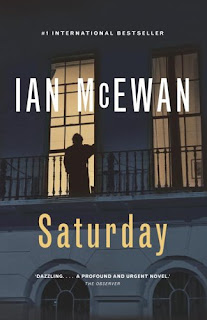

Okay, so I was still totally buzzing around on my Atonement high (see slightly hysterical post a few down) and was expecting to be dazzled yet again by McEwan's prose. Which proved ironic, because my main problem with this book was the prose. The vast, vast amount of prose. This book takes place over a single Saturday in a prominent London neurosurgeon's life. He wakes up, sees a plane on fire, has sex with his wife, gets in a minor car crash, plays squash, goes fish shopping, sees his mother, and then meets up with his family for what proves to be a very dramatic dinner. This may seems like a lot of activity, but this book is 290 pages long. And that is all that happens. This is the kind of thing that can be summarized in a few pages in another novel. Here, the majority of the novel can be taken up by Henry thinking about things. Henry loves to think. He just thinks and thinks. At one point, directly after the car crash, Henry thinks about the accident and other things for seven entire pages before even beginning to consider getting out of his car. See, that kind of thing pisses me off in a novel. Atonement had flowery and often exhaustive prose, yes, but the multi-narrative story and the riveting plot drove the reader along. Here, there is no plot to speak of, only a vague sense of uneasiness that is hardly enough to help me plod through another fifteen pages of Henry brooding about his age or the war or his sex life. Also, although the plot was centered around a huge anti-war protest happening in London, I thought the musings on terrorism and Islamic fundamentalism were out of place in a story about the wealthy forty-something doctor living in London. I understood what McEwan was trying to do with it- convey the message that although we may feel safe in our insulated lives, violence lurks at every edge and can suddenly intrude without our consent. It's a theme that works and probably the best take-away from the book, but I thought Henry's excessive focus on the Islamic aspects of this fear were overkill, even with the Iraq war and 9/11 lurking in the background of the book. Unless McEwan meant to imply that we are being taught to fear the wrong things? If that's the case, I concede the point to him. 

Okay, above rant aside, I did not hate this book. I was strongly, strongly temped to give up on it halfway when all the stuff above was overwhelming me, but since I had to finish it, I did, and the ending saved this book. I won't give too much away, but when Henry gets out of his head for five minutes and acts, the messages of the book come together wonderfully and I, at least, began to like him for the first time in the book. The finally surgery scene in particular was well done, and I think the book is worth it for that. Just plan on mucking through a lot of words to get there.

In summary: I spent 90% of the book hoping for the death of the main character so he would finally shut up, but in the end the book is an interesting look into the violence lurking at the edges of our comfortable world.

Book Ten: Timbuktu, by Paul Auster


Oh, man, I had high hopes for this book. Really I did. It was a book about a dog, and I am the world's biggest lover of dogs. It is no exaggeration to say that one of the best parts about being home for the holidays was getting tackled by my lovely mutt. On the other hand, I was worried about this book, because for some strange reason I am one of those people who can read about brain surgery and people getting pushed down stairs without a flinch (see above), but if a dog gets kicked in a novel I get all teary-eyed. This is such a problem that I still refuse to see I Am Legend because I heard (spoiler alert) that the dog dies. So I went into this book expecting a strong emotion either way and got....nothing, really.

This is a simple story. Dog has master, dog loves master, master dies, dog goes looking for new master. And Mr. Bones, the dog, really is a loveable character, and it is interesting that the book is told from his point of view. The real strength of this novel, I think, is the palpable feeling of love you can feel from Mr. Bones to his master. Everyone who's every owned a dog knows about the bond  I'm talking about, and Auster paints it beautifully from a dog's perspective. But once the beloved master dies, the storyline dies with it. With only the vaguest sense of plot - Mr. Bone's search for a new home - the book plods along unevenly, with no great revelations or particularly dramatic moments, and then stops suddenly and with no preamble. When I put down the book, I wasn't content or lost in thought, like I usually am when I finish a good book. I was confused as to why I had just read the thing. If there was a point, I couldn't find it.

Not to discredit Mr. Auster, but there is a short story I love told from a dog's perspective by one of my favorite people in the world, Dave Eggers. It was shared to me by a friend and I think it succeeds in bringing us into the world of a dog much more eloquently than this novel does. It is brilliant and heartbreaking. Read it right now.

In summary: Yeah, I love dogs, and Mr. Bones loves his master, but what was the point?

Book Eleven: The Nun, Denis Diderot 


At last, close to the end! This is a lot of writing, whew. Alright, The Nun. I was expecting this book to be boring as hell. In parts, it was. What I was not prepared for was the excellent dialogue, drama, and crazy illicit lesbian romance. Jesus, this must have been a controversial book in its day. The plot centers around Suzanne, a young girl coerced into joining a covenant because she is prettier and smarter than all of her sisters and is getting in the way of marrying them off because she is so much better in every way. Oh, and also because she's the illegitimate offspring of her mom's fling with some asshole, and this is her mom's way of "atoning". Go Mom. Once she's in there, she's forced to take the vows of a nun, which she very definitely does not want to be. Forced into the convent, she rebels and begins a long fight to leave, which causes the other nuns to starve her, throw broken glass on her, insinuate that she was raping the young converts, spit on her, and tell everyone she was the devil. For a book written in the 1750's, this is the equivalent of a soap opera. 


For a book written by a man as a joke, this is a book that does deal quite deftly with the issue of a women's freedom - or rather, lack therof. From a modern standpoint, it's crazy that a girl's father could pay someone to lock her up in a nunnery, and despite years and years of protest and struggle, she still couldn't escape. This wasn't a house of God, it was a prison. This is also a really great study of group mentality and the absolutely batshit things people do when they've trapped in close quarters with nothing to do but pray all day long. Although I sometimes wanted to give Suzanne a good shake (the girl is more innocent than some five year olds I know) I had to admire her tenacity and her refusal to bow to her circumstances. 


In Summary: I was excepting to read a terribly dry book about some devout old woman knitting, or something, but instead I get this sharp, thought-provoking and terribly entertaining novel. Might have to rethink that prejudice I have against "old" books...


Whew. 1% DONE!! This is gonna take a long time. Alright. Off to enjoy my last night of freedom. Happy New Year, everyone!


Thursday, December 23, 2010

Book Seven- Heart of Darkness


When I read this book the first time I only underlined one sentence.

"And this also," Marlow said suddenly, "has been one of the dark places of the earth."

I think that pretty much sums it up. When I read this book the first time it was for school and I was racing to get it done so I could go out or watch TV or write an essay or something, and when I read very very fast I don't really remember specifics, just a general impression, and in my memory this book was dark tangled trees and white teeth and silence and a snatches  of conversation that got nowhere and served no purpose. Now that I am finally free of finals and home for a little while, I could curl up with this book and read it properly, no rush.

What can you say about Heart of Darkness that hasn't been said a thousand times in a thousand high school English classes? The nature of savagery and civilization, the racism, the insanity, the "horror?" There is no question that it is a brilliant book and deserves to be a classic. Conrad deftly conveys the idea that modern man is a stranger to his own Earth, and although the book can get a little too long-winded or clever for its own good, you do walk away with a vague sense of dread at the end, and I think that's what Conrad wanted all along. It is this sense of fear that is the true strength of the book, and what I related to the most in it.

Now, I'm a pretty well traveled person, I've slept in my car or in the dirt more times than I'd care to admit, and I've been to places I consider pretty remote (though definitely not as remote as colonization-era Africa). And I will tell you, there is nothing like walking in a silent, dark forest at night to destroy any ideas that nature has been tamed. There is some....I don't know. Some kind of presence there, that makes you feel so small and uneasy. Something force that has been operating far longer than you could ever imagine and is utterly indifferent to you.

I felt that again, reading this book, especially the part where Marlow follows Kurtz into the forest, with the drumming and fires and dark shapes in the foliage, "the heavy, mute spell of the wilderness.....the awakening of forgotten and brutal instincts...the memory of gratified and monstrous passions." "You will be lost," Marlow says to Kurtz, trying to keep him from going farther. "Utterly lost." But I think both men understand that Kurtz wants to be lost, that he has already gone over the precipice, and now there is no coming back.

In summary: If Joseph Conrad can make me afraid of the dark when I am sitting on an comfortable armchair in my living room with a bright winter day outside, then I consider that a job well done.

Wednesday, December 15, 2010

Book Six- Atonement


Oh, Atonement. This is one of those very very rare books that I saw the movie before I read the book, and I remember watching the movie with disappointment (I think I was under some sort of impression that it was a chick-flick, which IT WAS NOT, WOW) but then I read the book and it put the movie in a whole different light. I re-watched the movie recently found it amazing, of course. It's funny how that can happen. The one scene where Robbie has just given Briony the wrong letter and she runs off into the fields, and the music is twanging on wrong notes in the background and the typewriter noise starts up and you see him just barely cock his head, and the the whole scene seems to take a deep inhale and the camera sweeps over and centers just on his back, how stiff it is, and everything goes silent. And then he realizes, you can see him realizing it, the pivoting moment that causes the ball to tip and sets everything rolling towards the inevitable...wow. Sorry for the gushing, that scene is just so brilliant in the movie, I even called my flatmates over and made them watch it. 


ETA: OH JESUS HERE IT IS. It so perfect, I can't even...with the letter tapping and everything! He's so cocky, he has no idea what's coming to him, but you can see when he realizes, just gets a glimpse of the slope he's standing on the edge of...oh, just watch it.


Letter Scene from Atonement (CLICK HERE)


Anyway, this is about the book, not the movie. Ack, my feelings about this book are all mixed up right now. If I went into it I would talk a lot of destiny and fate and the sickness of war but I don't want this to sound like a book report, that would be horrible and completely scrub this amazing book of it's remarkable melding of hope and hopelessness, which is what I loved about it at the end. 


A few quick impressions:


- It is incredible how well McEwan writes children, especially children like Briony. I was that child. I was a young writer and so caught up in my own cleverness and convinced that no one ever in the history of the world had had these deep thoughts like mine and once everyone realized how revolutionary I was they would be shocked and/or awed. This line especially, "Was everyone else really as alive as she was? For example, did her sister really matter to herself, was she as valuable to herself as Briony was? Was being Cecilia just as vivid an affair as being Briony? Did her sister also have a real self concealed behind a breaking wave, and did she spend time thinking about it, with a finger held up to her face? Did everybody, including her father, Betty, Hardman? If the answer was yes, then the world, the social world, was unbearably complicated, with two billion voices, and everyone’s thoughts striving in equal importance and everyone’s claim on life as intense, and everyone thinking they were unique, when no-one was." I thought about that all the time when I was a kid, even now. Funny how with Briony it seems so innocent, until it becomes sinister. 


-The multi-view narrative works so well, especially at the beginning. You can see just how clever everyone thinks they are and how well they have it all figured out (especially Emily, who really is completely clueless) and how none of them, not one, can see the truth for what it really is, preferring to stick to their own narrowly understood view of the world. So Briony becomes the one guilty of letting  her imagination drastically change real life, but really they are all guilty of it, even Robbie and Cecilia. 


-The war. Whenever I read about war I can only think how- how can men keep going like that, no hope, no order, flushed of their humanity, ready to die at any instant? And how do they keep doing it? His prose is so heartbreaking here- Robbie in the basement, with his strange, heavy baggage, and telling Nettle he needs to stay on for a bit, take care of some business...


-Luc Cornet. Books don't usually make me cry.


-The end is perfect. Swings it all around full circle. Briony got them into the mess by wanting to believe in fate and plot and an orderly balance of right and wrong. She got into it because she believed in villains and heroes and happy endings, and we see in the middle how she has come to reject all these things so throughly. But at the end, she uses them once more to lend out tiny measure of happiness to a stupid, senseless, tragic story. The last thing she can do to atone. Is it a worthless gesture, a cheap trick?  Maybe. But it does make us feel better, if only for a moment. Then Ian McEwan breaks our hearts all over again. He's just so damn good at it! 


In summary: Watch the movie, read the book, and if you're like me you will cry a little and stay up way too late reading it and even possibly realize what a precocious little child you were. Just read it.

Saturday, December 11, 2010

Book Five- The Death of Ivan IIyich


Another day, another book to aid my procrastination. The Death of Ivan Illyich is another one of those books I had to read in some far-away classroom and haven't picked up again since. It's strange, a lot of the art I've encountered recently has dealt strongly with the themes of death- a recent movie I watched, the Iron & Wine song "Die" I've become obsessed with, and this book. Reminders of death are always skirting around us, yet we choose to see them as harmless, nothing more than entertainment. And that's kind of the whole point Tolstoy tries to make, isn't it? That those of us living see death as some kind of faraway thing, which cannot intrude without our permission. We do our best to shut our eyes and ears to it, but it comes all the same, as Ivan Illiych discovers. Whenever I recall this book, it calls to mind a piece of art by Damien Hirst, a famous British modern artist. The art itself is a dead tiger shark preserved in a tank of formadelhyde, but what gets me isn't the shark itself, but the title of the piece, "The Physical Impossibility of Death in the Mind of Someone Living."

The book itself is a very quick read-  a retelling of the "successful" life of Ivan Illyich, his industrious career, his marriage to an agreeable woman, his nice house full of trinkets and antiques. But when he falls ill, none of this seems to matter anymore, and slowly slipping into death's embrace, he is forced to reconsider the purpose of his entire life.

And what a sad book it is! To realize -on death's door - that,

"his scarcely perceptible attempts to struggle against what was considered good by the most highly placed people, those scarcely noticeable impulses which he had immediately suppressed, might have been the real thing, and all the rest false..."

Well, let's hope that none of us feels that way, when Death comes for us. Here, Tolstoy makes several points that might seem obvious to modern readers but which were surely very wild indeed for nineteenth century Russian society. In a little novel about the death of an unimportant man, Tolstoy manages to deftly put aside the desire for power, money, rank, and all the trivialities of high society, and instead assert that, for Ivan Illyich at least, sucking the pit of a wild plum in childhood was truer happiness than anything else that had followed. However, Ivan Illyich dies shortly after realizing this, and cannot act on this newfound revelation. But the question remains: if he had recovered, would he have changed his ways, or is death necessary to reveal truths which have been buried within us for a lifetime?

In summary: A quick read, but not a light one. Memento mori, and happy Saturday!

Friday, December 10, 2010

Book Four- 1984


So. 1984. I was forced to read this book for school when I was about fifteen, but I haven't re-read it since, and I forgot what an utterly terrifying book this is. Apocalyptic literature is one of my favorite genres and I've read all the classics in it, but before this re-reading I wouldn't have listed 1984 among my favorites.  I liked the book when I read it in school, sure, but I think the first time I read it I was too young to really understand its significance. All I remember from the first time around is being really frustrated by the ending, which made absolutely no sense to me. But now reading from a (slightly) more mature standpoint, I can see that the ending is the real terror of the book. You are confronted on all sides by an insane society, and to retain your own sanity, you must go insane with it. The book is full of paradoxes like this, and that's what makes it so difficult to wrap your head around - that kind of society is so alien towards us, and yet we understand how it could come to be. 

I was especially interested in the themes of insanity and relativity in this book, because it's something that comes up a lot both in my studies of neuroscience and religion, especially eastern religions (yes, I have a strange, strange double concentration in biology and religion, something which is great for books like this!) Winston is constantly struggling with the very concept of reality - if something cannot be touched, held, or examined (like the past) is it real? Or is a flawed projection from our own minds? If I say I saw a bluebird on the tree, and you agree that it is there, I accept that the bird was there. However, if five minutes later I ask you about it, and you deny it ever existed, I being to doubt a past that I personally witnessed. If personal past is can be made to seem mutable, impersonal past might as well be a fairy tale. And if I persist in believing the bluebird was there, even if you insist that it was not, then I begin to doubt not only reality, but my very sanity. The incredible loneliness of this "minority of one" - that is the struggle Wilson must face, and ultimately succumbs to. 

Orwell's prediction may have been averted (for now) but what he truly succeeds at is the creation of a society which, theoretically, cannot be defeated. I was reading this book and trying desperately to think of a way that resistance could be mounted, humanity regained, any of it, and every time was countered just as Wilson was. The only hope lies in what are sometimes called "human impulses" - that is, to strive for freedom and love and kindness above all things, and to resist the kind of evil perpetuated by the Party on instinct. However, if what the Party is saying is correct, there is no such thing as this base human nature, only an endlessly programmable machine that can be wired to accept power and hate as replacements for softer emotions felt by previous generations. This is another question that science and religion has struggled with - is man the proverbial "black box", who can be broken down and reassembled as easily as a computer, or is there some inherent nobility in him, some remnant of the divine? Orwell seems to take the former viewpoint, but others have not been so pessimistic. You could find plenty of evidence for both sides, but that's a debate for another day. 

Whew. Really started to wax poetic there for awhile. God, I miss English classes. In summary: 1984 is brilliant and bleak and terrifying and let us all be happy that we do not live in an insane totalitarian universe where our government wants to stick people's heads in rat cages. Or do we? Hmmm.....